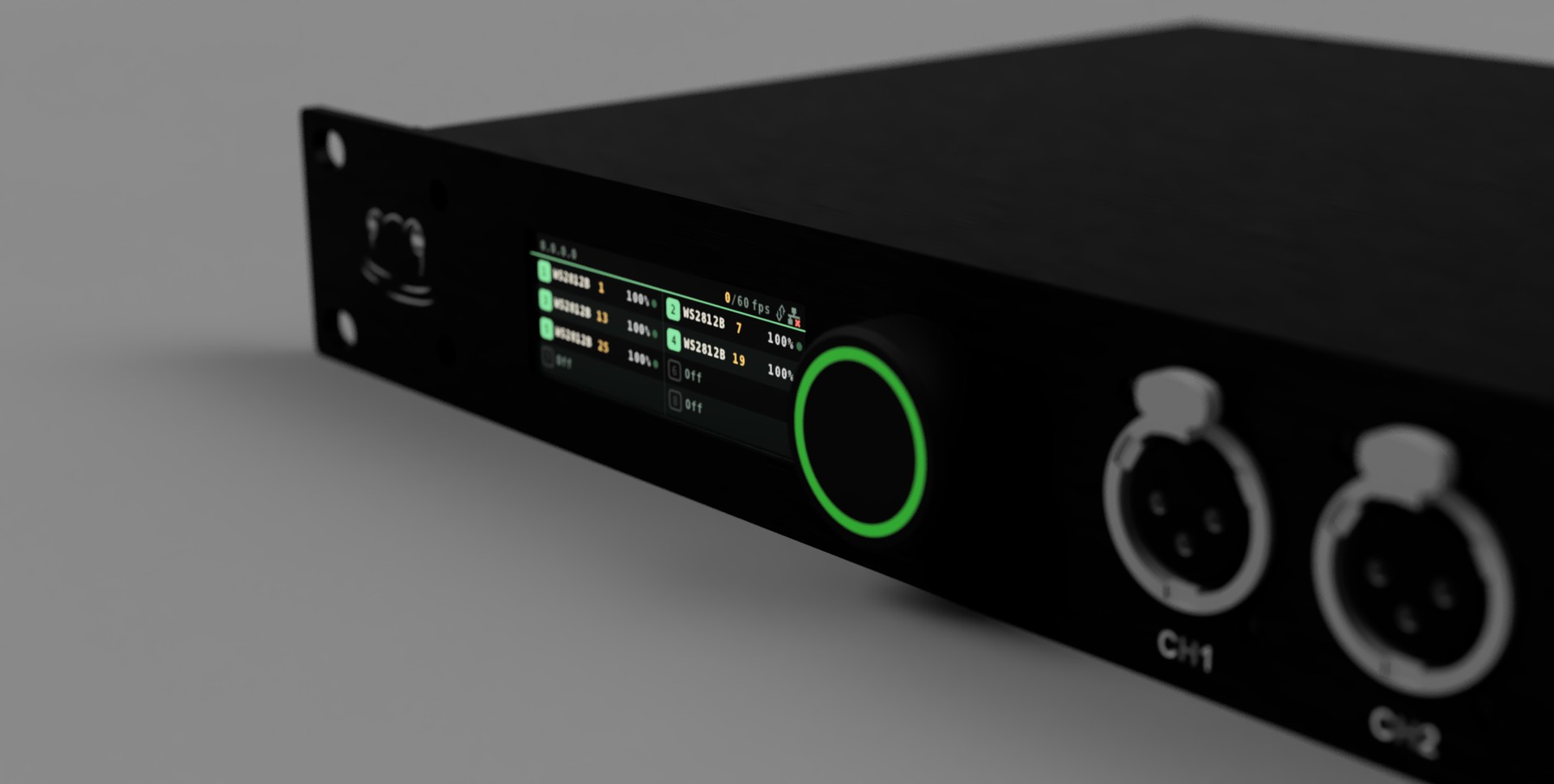
Open-source LED lighting, from control to fixture
pixfrog is a complete open project: the Art-Net 4 / sACN controller firmware on the ESP32-P4, the 1U rack, the electronics that condition the bus, the power satellites at the far end of a run, and LED bars coming next.
A complete rack — open, and documented.
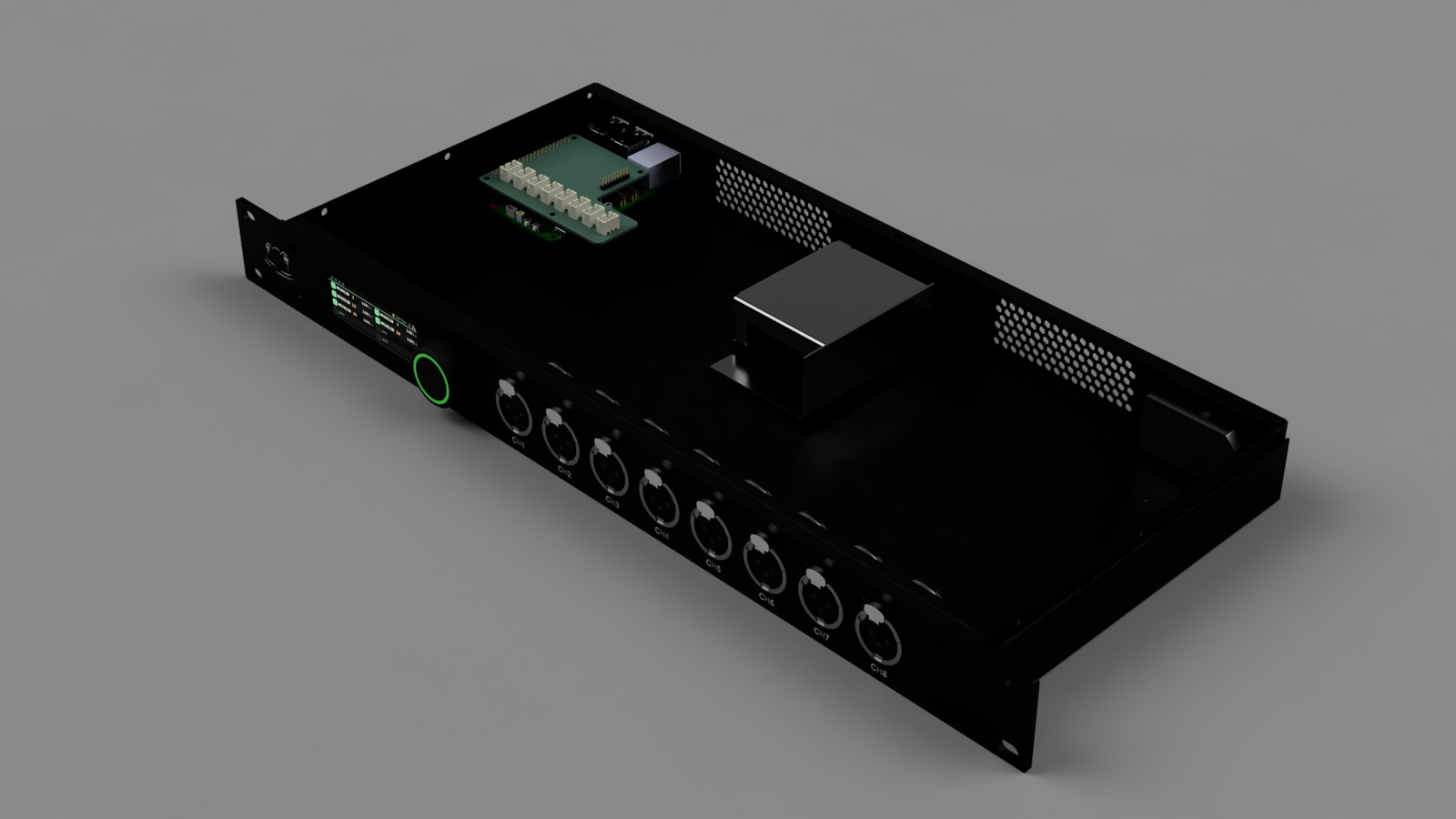
Daughterboard on pluggable terminal blocks, supply on its own. Everything is replaceable, everything is published.
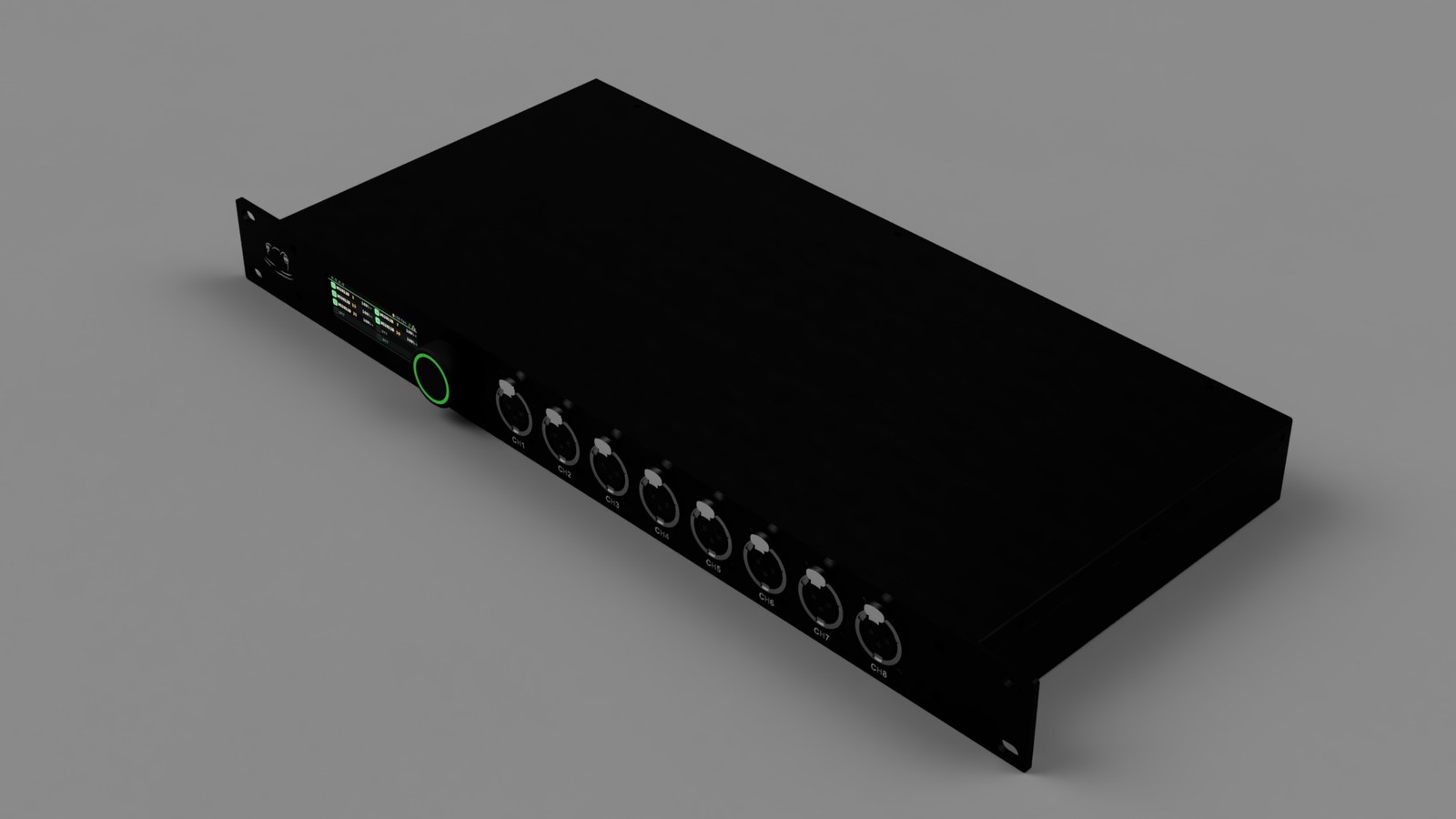
Outputs labelled CH1 to CH8, standard rack ears, passive ventilation. Patching happens at the front panel, with nothing to dismantle.
The desk is on the front panel. The detail is in the browser.
The on-device display shows network, services and per-channel activity at a glance — protocol, universe, pixels, brightness and a live status LED per output.
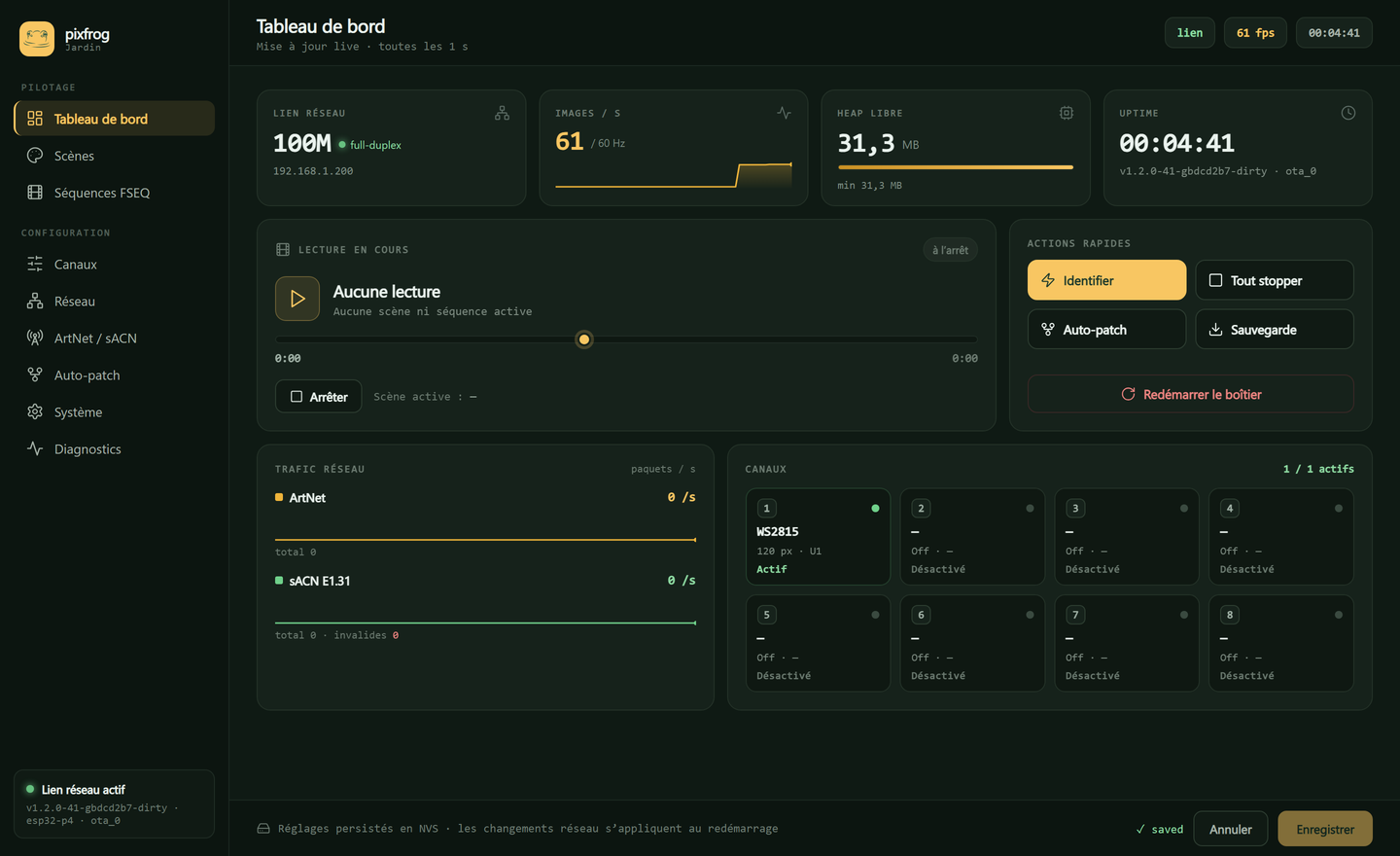
Link, FPS, Art-Net and sACN traffic, scenes and sequences — served by the device itself.
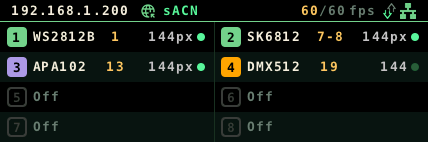
IP, active protocol, FPS and all eight channels at a glance.
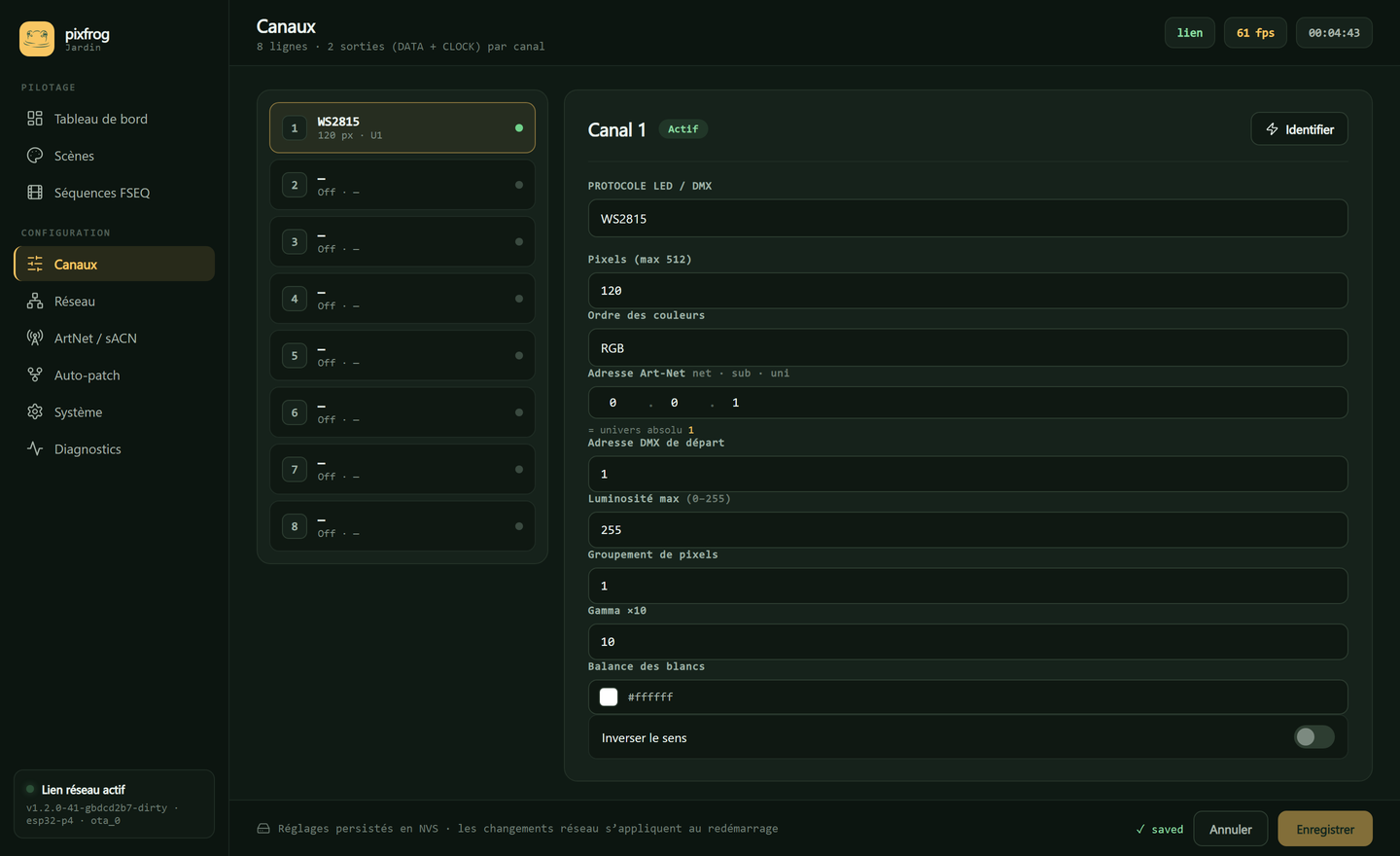
Every output, field by field, saved to NVS.
Built natively on ESP-IDF, tuned for deterministic timing.
9 pixel protocols
WS2815, WS2812B, WS2811, SK6812, WS2814, APA102, SK9822, LPD8806 — with per-channel color order, gamma and brightness.
Art-Net 4 + sACN
ArtDmx, Sync, Trigger, TimeCode and remote config over Ethernet; opt-in sACN (E1.31) with priorities and 2-source HTP/LTP merge — up to 48 universes.
Parallel DMA output
The ESP32-P4 PARLIO peripheral clocks all 8 channels in parallel out of PSRAM double buffers via DMA for rock-steady, jitter-free refresh.
On-device UI
Colour TFT status dashboard (or classic OLED) driven by a rotary encoder — live FPS, link, per-channel activity and full configuration, no laptop needed.
Web UI & OTA
Opt-in embedded web app: full configuration, live status, OTA updates with A/B rollback, JSON backup/restore, coredump download, optional auth.
FSEQ player
Plays xLights/FPP .fseq shows from microSD
(zstd, hot-plug), free-running or slaved to ArtTimeCode and
FPP MultiSync.
Scenes & failsafe
8 standalone scenes (solid / chase / rainbow) playable at boot, from the desk or any UI — plus a per-channel signal-loss failsafe.
Persistent config
Every setting is stored in NVS and survives reboots, with a loud warning on the home screen if flash goes bad.
Octal PSRAM
200 MHz octal PSRAM holds the double-buffered frames while DMA-capable SRAM keeps the output path fast.